
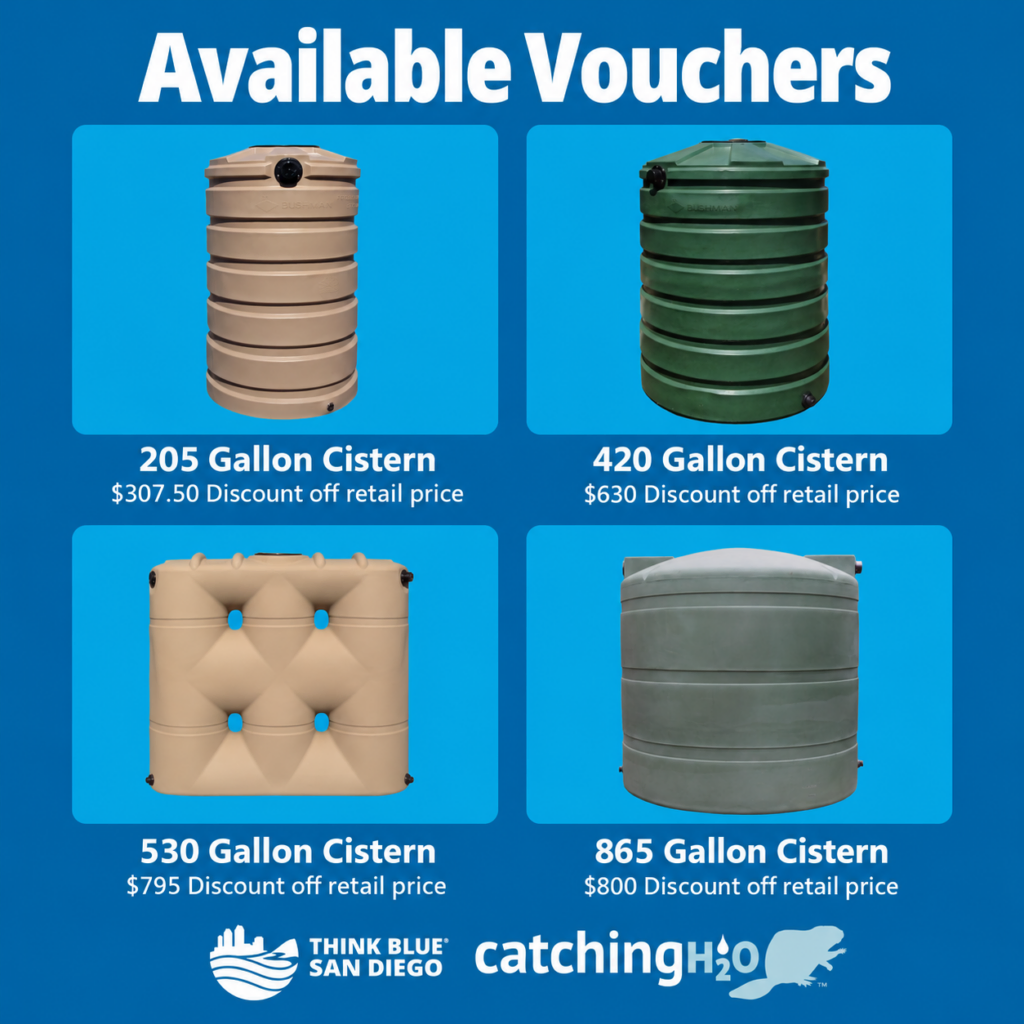
A look at the four tank sizes available through the City of San Diego’s Think Blue Rain Tank Voucher Program, and what to consider for your own yard.
Where could a rain tank go at your home? Maybe beside a garden, near a downspout, or along a narrow side yard. Seeing tanks in real spaces can make that question easier to answer. Through the City of San Diego’s Rain Tank Voucher Program, eligible residents can purchase one of four rain tanks at an upfront discount. Catching H2O is the program’s tank vendor partner.
How does the Think Blue voucher work?
The voucher reduces the price of an eligible rain tank when you purchase it, rather than reimbursing you later. City of San Diego residents can apply through Think Blue.
The City allows up to two 205-gallon tanks or one 420-, 530-, or 865-gallon tank. Renters may apply, but should get permission from their property owner before installing a tank. Individual units in multifamily buildings may also be eligible. Vouchers are available on a first come, first served basis while funding lasts. Check the City’s current program page for eligibility, application steps, and the latest terms.
How the parts work together
Roof runoff moves through the gutter and downspout to a leaf filter, which screens out leaves and larger debris. If installed, a first-flush diverter directs the initial runoff away from the tank before the remaining water flows through the inlet pipe into storage. Once the tank is full, the overflow carries additional water to a planned drainage location.
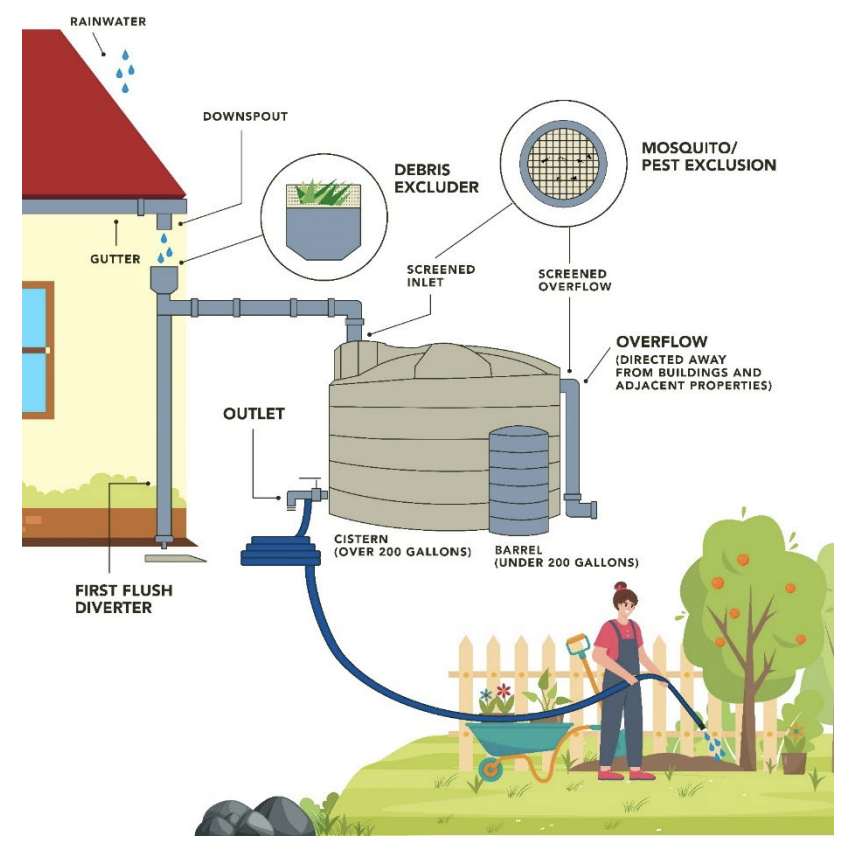
Rainwater harvesting system components. Illustration from Think Blue’s Rain Tank Installation Guide
Compare the tank sizes
| Capacity | Shape | Approximate dimensions |
| 205 gallons | Round | 35” diameter × 60” high |
| 420 gallons | Round | 45” diameter × 64” high |
| 530 gallons | Slimline | 25” deep × 86” long × 78.5” high |
| 865 gallons | Round | 64” diameter × 66.5” high |
Four tank sizes, four ways to think about space
The projects below feature the four tank sizes offered through the Think Blue Tank Voucher Program. Some customers installed their tanks themselves; others worked with Catching H2O on part or all of the installation. Each photo shows a different way to make rainwater storage fit the site!
205 gallons: Start with a smaller footprint
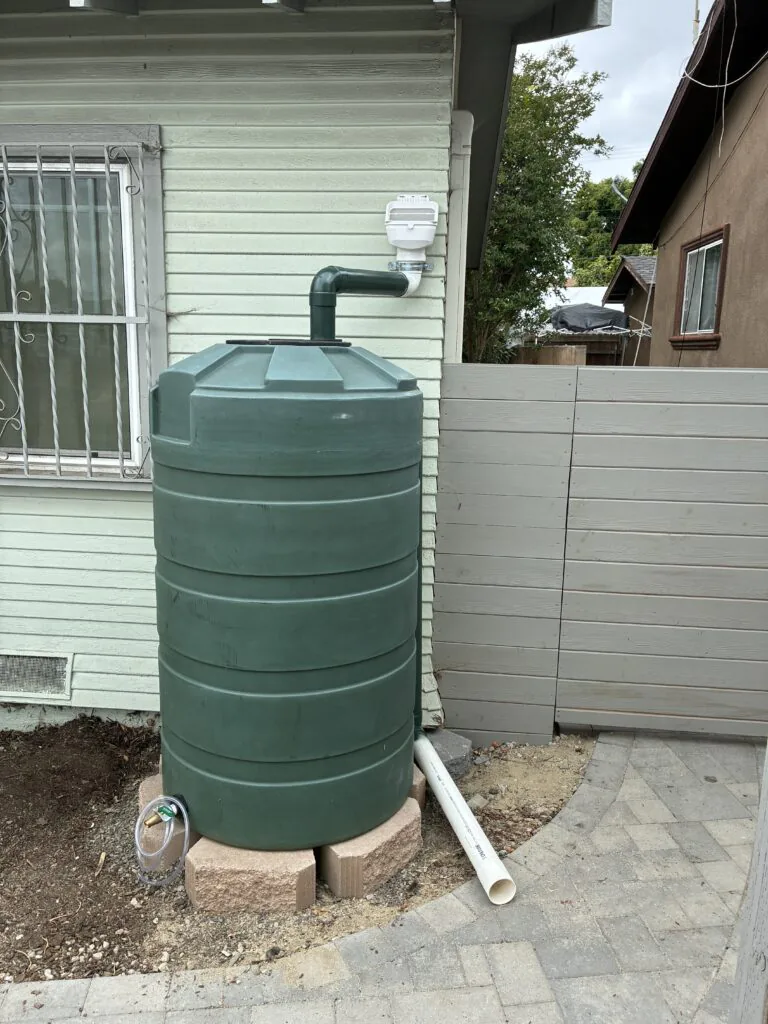
Approximate tank dimensions: 35 in diameter × 60 in high
The 205-gallon round tank has the smallest footprint of the round models in the voucher program. Participants may choose two 205-gallon tanks, for 410 gallons of combined storage, if that arrangement suits their site. At this home, this tank collects runoff from approximately 250 square feet of roof. Starting empty, it can fill with about 1.3 inches of rain. Once connected, the downspout carries roof runoff to the leaf filter, and the inlet pipe directs it into the tank. The downspout connection had not yet been installed when this photo was taken, but the leaf filter is visible above the tank. Its removable screen catches leaves and larger debris before water enters the piping. Keeping the screen clean helps reduce debris entering the tank.
420 gallons: More storage in a round tank
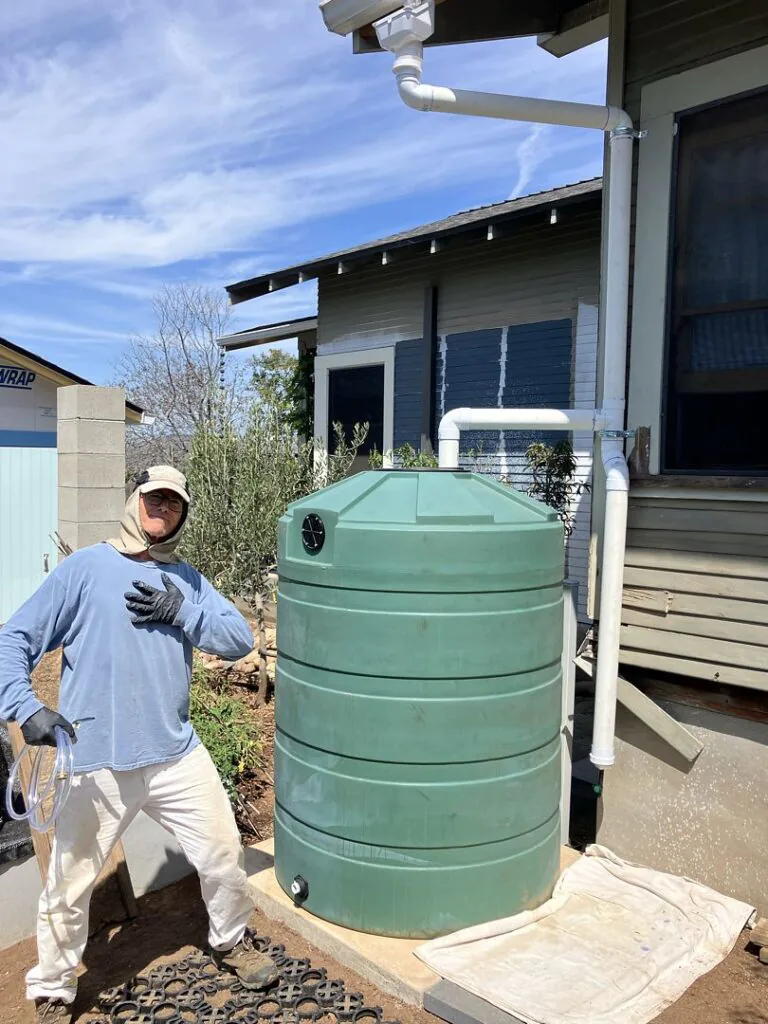
Approximate tank dimensions: 45 in diameter × 64 in high
The 420-gallon tank needs a wider spot than the 205-gallon model. This customer installed his tank on a concrete pad with some installation support from Catching H2O. Our team guided him through the installation and helped connect the first-flush diverter and the pipe from the leaf filter to the tank. The customer was responsible for installing the overflow, which is not shown here. The pipe beneath the leaf filter also still needed support when this photo was taken. At this home, this tank collects runoff from approximately 1,000 square feet of roof. Starting empty, it can fill with about 0.7 inches of rain.
530 gallons: A slimline shape for a long, narrow space
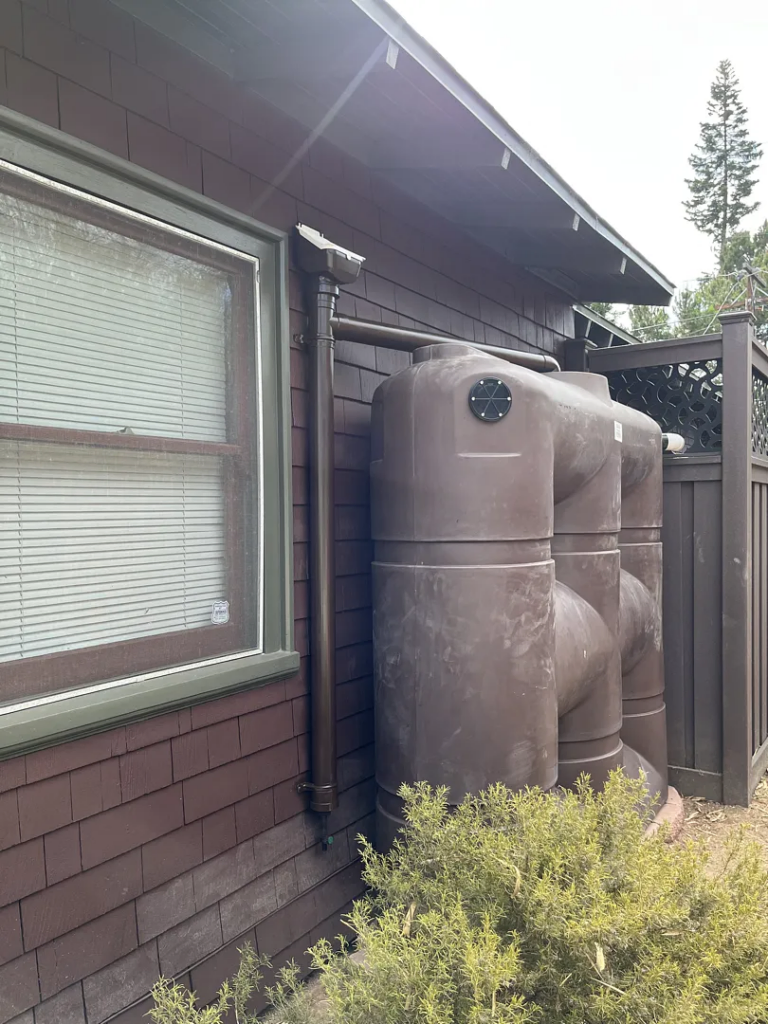
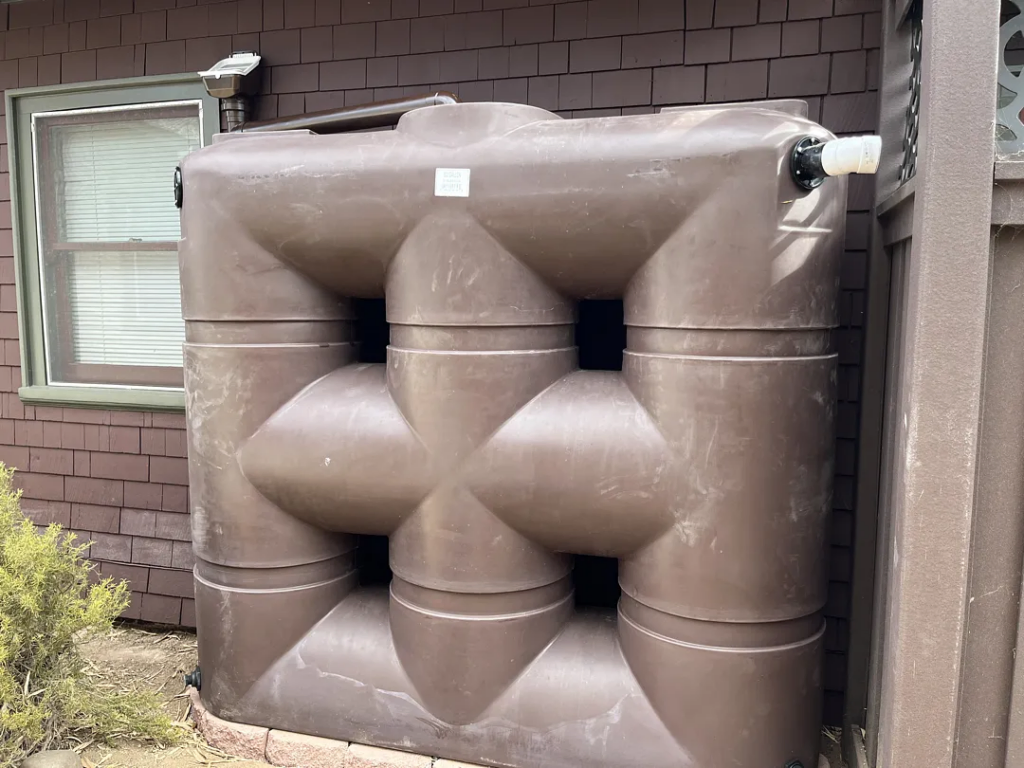
Approximate tank dimensions: 25 in deep × 86 in long × 78.5 in high
The 530-gallon slimline tank shape may suit a long wall or side yard where a round tank would be difficult to place. The tank still needs room for a suitable base, connections, access, and a safe overflow route. This tank belongs to a customer who also has 205- and 420-gallon tanks at their home. Here, the slimline model fits into a narrow side yard tucked away from the backyard. It collects runoff from approximately 540 square feet of roof and can fill from empty with about 1.5 inches of rain. The overflow connects to existing drainage. To make the water easier to access from the main garden, the hose bib is located farther along the house wall. The gutters had not yet been installed when these photos were taken.
865 gallons: Larger storage where the site allows it
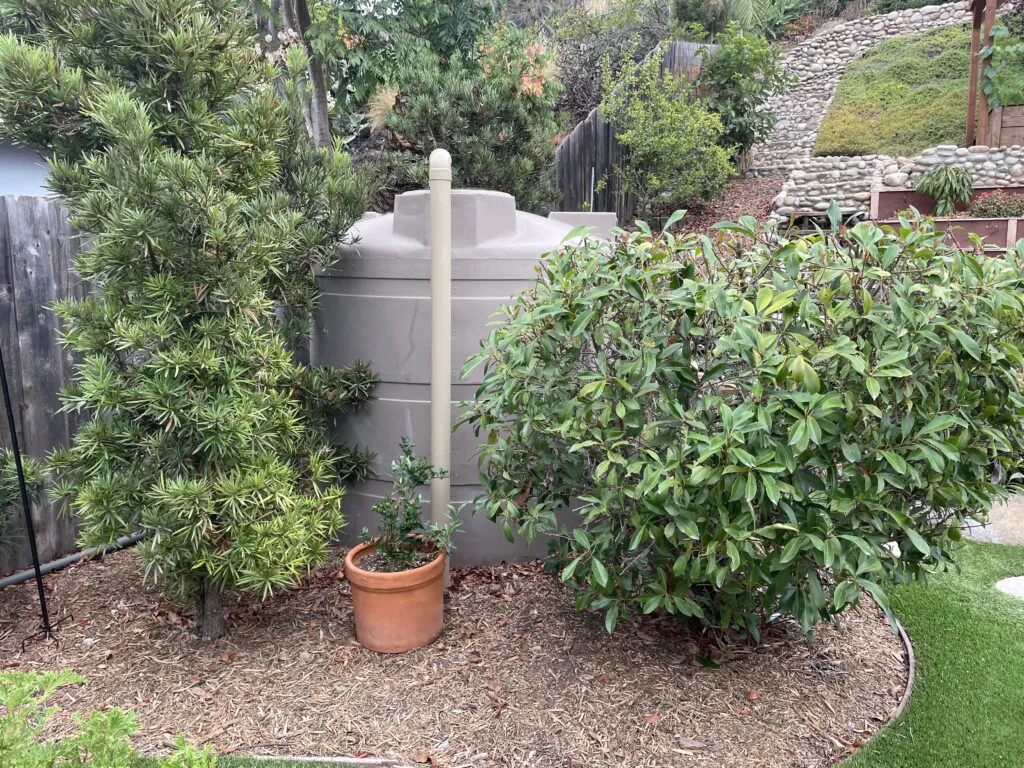
Approximate tank dimensions: 64 in diameter × 66.5 in high
The largest voucher-eligible model holds 865 gallons. Its footprint makes site planning especially useful: consider the downspout, a level base, access to the tank, and where water will go once it fills.
After purchasing the tank, this customer used Catching H2O’s DIY guidance to plan the base, leaf filter, first-flush diverter, and tank installation. The project uses a wet conveyance system. A wet conveyance system can help when a tank needs to sit farther from the downspout. Roof runoff travels down a pipe, through a low section of sealed piping, and back up to the tank inlet. Water remains in the low section between storms, which is why it is called a wet system. The pipe route and elevation need careful planning.
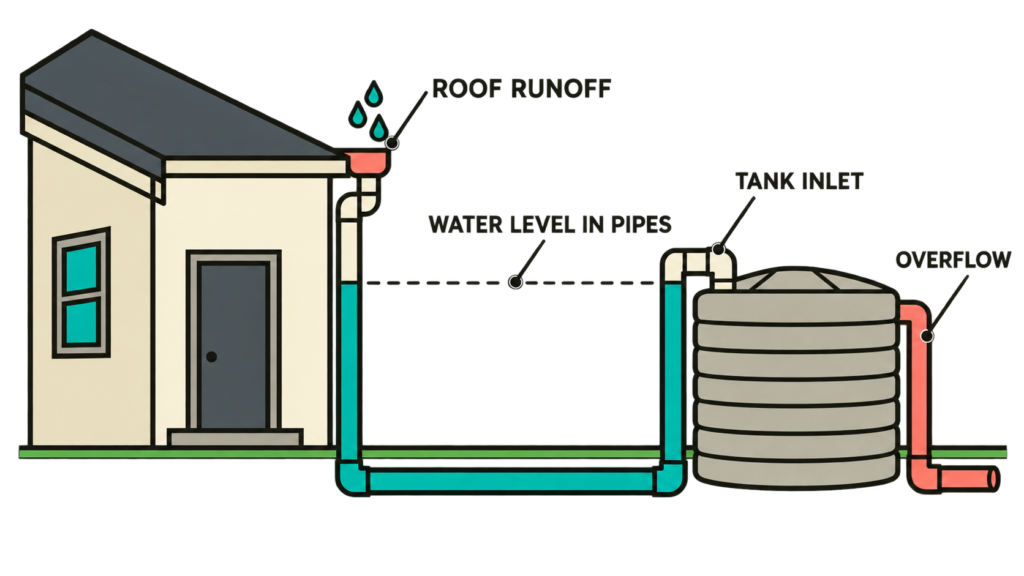
Wet conveyance system: sealed piping carries roof runoff through a low section and back up to the tank inlet.
Common questions before you choose a tank
How much room do I need?
Start with the tank dimensions above, then look at the whole route water will take: from the roof and gutter to the tank, and from its overflow to a safe destination. The tank also needs a solid, level base that can support it when full. Think Blue’s rain tank installation guide explains the main components and planning considerations. If you’re unsure whether a location will work, Catching H2O can help you assess it through a site visit. For additional tank sizes beyond the voucher program, explore our Rainwater Tank Solutions page.
Does the voucher cover installation?
No. The voucher provides an upfront discount on the eligible tank purchase. Installation, delivery, and any site-specific work are separate costs. Catching H2O offers DIY support, site visits, and professional installation; contact us for help choosing an option and getting a quote.
Can I install the tank myself?
Yes. Some customers choose a DIY installation, while others want guidance or a full installation. Whatever route you choose, plan for a stable base, a screened inlet, and an overflow that directs water away from buildings and neighboring property. Follow the manufacturer’s instructions and applicable local requirements. Catching H2O offers DIY guidance and site-visit support if you’d like help planning the details.
Ready to explore your options?
Start with the Think Blue voucher application and program details. Have questions about tank size, pickup, delivery, or installation? Email us at sales@catchingh2o.com.