
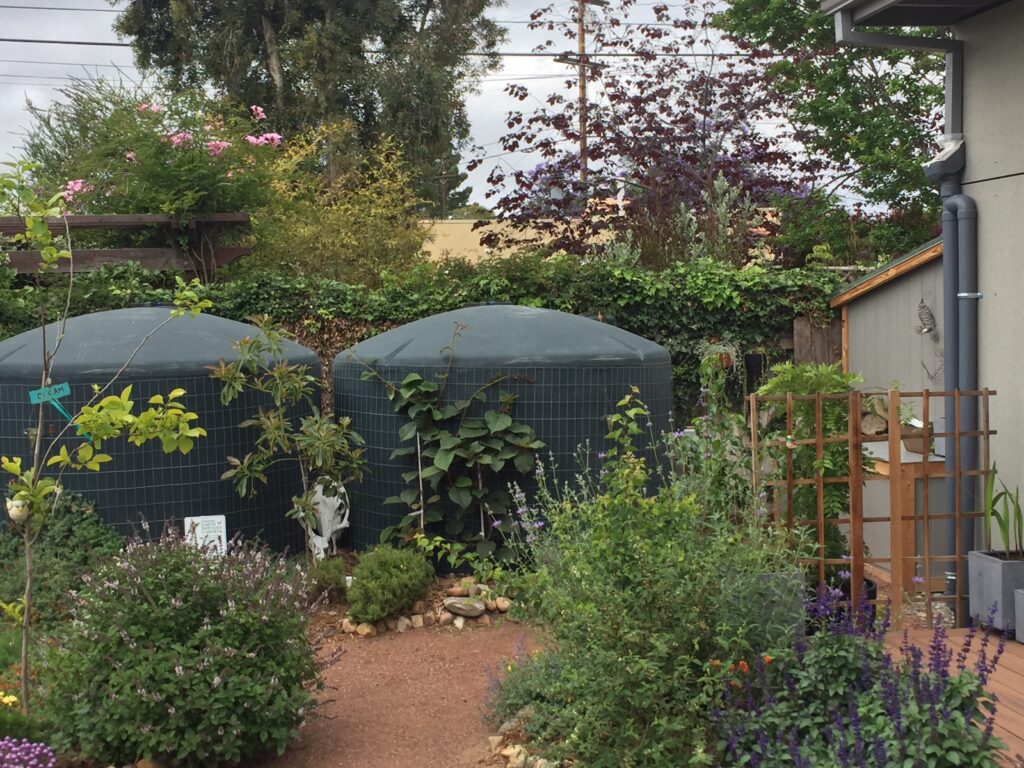
San Diego receives less rain than much of the United States, but a storm can still send hundreds of gallons off your roof. How much rainwater could you collect at home? That depends on the roof area connected to a downspout, rainfall, and how much water your tank can hold.
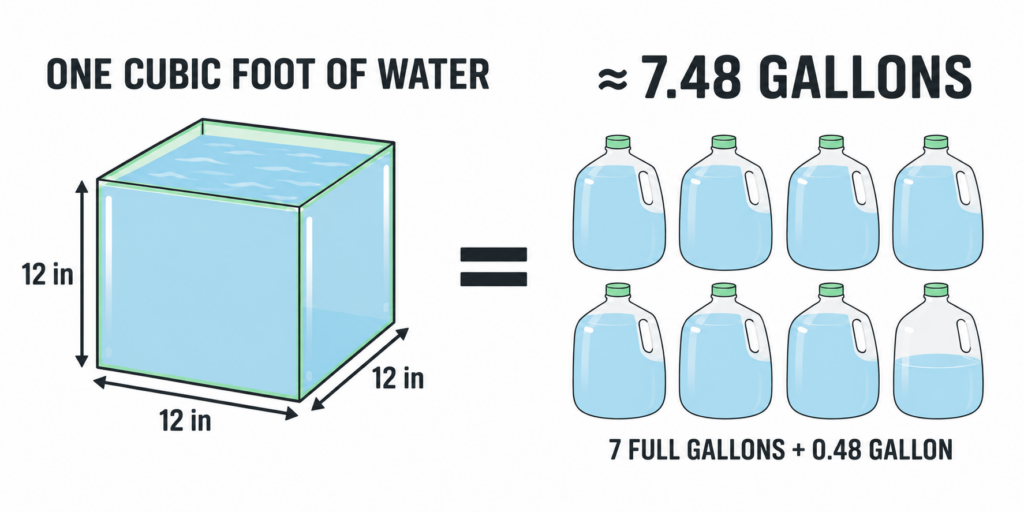
A 1,000-square-foot roof can shed about 623 gallons in a one-inch storm. Half an inch of rain could produce around 312 gallons from that same area. How do we calculate that? One cubic foot of water holds about 7.48 gallons. One inch of rain falling on one square foot of roof has a volume of 1/12 cubic foot, so it produces about 0.623 gallons.
Connected roof area (ft²) × rainfall (in.) × 0.623 gallons/(ft² · in.) = potential runoff (gallons)
For a 1,000-square-foot roof in a one-inch storm: 1,000 ft² × 1 in. × 0.623 gallons/(ft² · in.) = 623 gallons. That’s a lot of water from one storm! Let’s work out what your own roof could do.
Estimate your roof’s rainwater potential
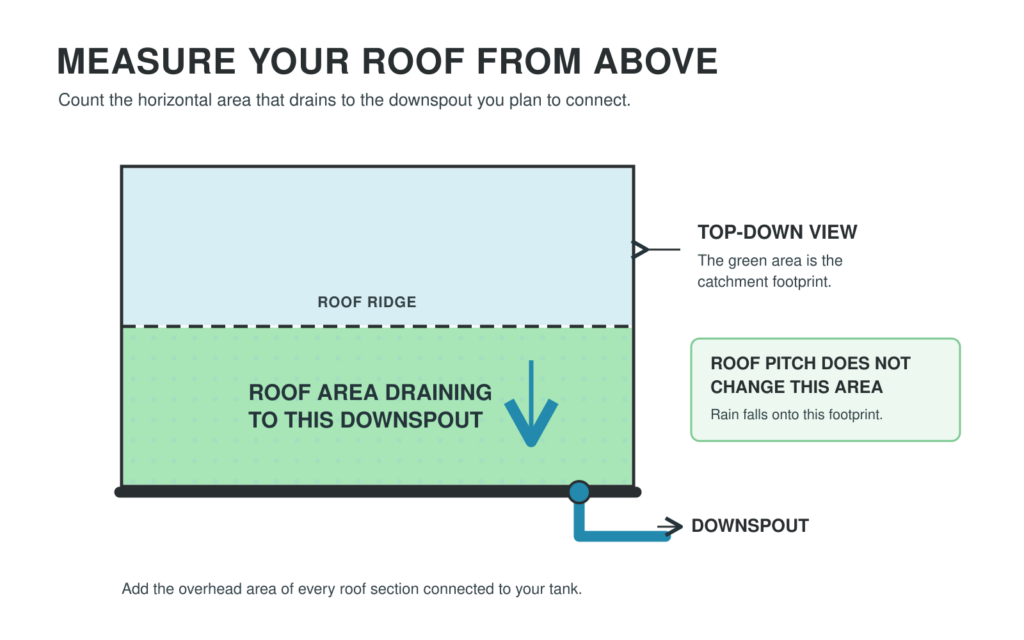
Start with the overhead footprint of the roof area draining to the gutter or downspout you plan to connect. Imagine looking straight down at the house: if only one section of the roof drains toward your proposed tank, estimate that section rather than the entire roof. For a first estimate, use dimensions from a site plan or approximate the length and width on a map.
1. Pick the downspout(s) you might connect to a tank.
2. Estimate the overhead area of the roof draining to them, in square feet.
3. Multiply that area by 0.623, then by rainfall in inches. Try both 0.5 inches and 1 inch.
4. Compare the results with the tank size you’re considering. Think about whether you’ll be able to use the stored water before the next storm.
Here’s what half an inch of rain could produce:
| Roof Area Connected to the Tank | Potential Runoff |
| 500 square feet | About 156 gallons |
| 1,000 square feet | About 312 gallons |
| 1,500 square feet | About 467 gallons |
Potential runoff from a half-inch storm. Calculation: 0.623 gallons per square foot per inch of rain.
How much rainwater could your roof collect in a year?
For a simple planning example, let’s use 10 inches of annual rainfall, a rounded coastal example used by the San Diego County Water Authority. Actual totals vary by year. On a 1,000-square-foot connected roof, 10 inches works out to roughly 6,230 gallons of potential runoff over the year.
You do not need a 6,230-gallon tank to benefit. The total is spread across separate storms. A tank can fill, be used to water your garden, and refill during the next rain. On the other hand, if it is already full when another storm arrives, additional runoff will leave through the overflow. Plan a safe overflow route away from the house. Where the site allows, a rain garden can help that water soak into the landscape.
How quickly could your tank fill?
Take a 420-gallon tank connected to 1,000 square feet of roof. It could fill after about 0.67 inches of rain, assuming it starts empty. If there is already water in the tank, a smaller storm could produce overflow.
This is why choosing a tank is about more than matching its capacity to one storm. Consider how you’ll use the water between rains, how much room you have for storage, which gutters can reach the tank, and where overflow can safely go. Where site conditions allow, water that overflows from a full tank can sometimes be directed into a thoughtfully designed rain garden to soak into the landscape instead. Catching H2O’s rain-ready checklist also explains why clean filters and a working overflow matter once the system is installed.

A tank can supply landscape irrigation between storms. Illustration: Catching H2O.
Planning your gutters and tank size
Gutters are the number one way to ensure the water is routed efficiently to the place you want. How many downspouts you connect, and how far they are from the tank, affect the amount of piping needed. Connecting fewer downspouts that are closer to the tank can make installation simpler and less expensive.
If you have room, it is also generally more cost effective and more space efficient to get one larger tank than several smaller tanks. For example, two 420-gallon round tanks would provide 840 gallons of storage and cost $2,250 total ($1,125 each), while one 865-gallon round tank provides slightly more storage for $1,520. The best choice still depends on your available space, access, and installation needs.
Can one tank collect from multiple downspouts?
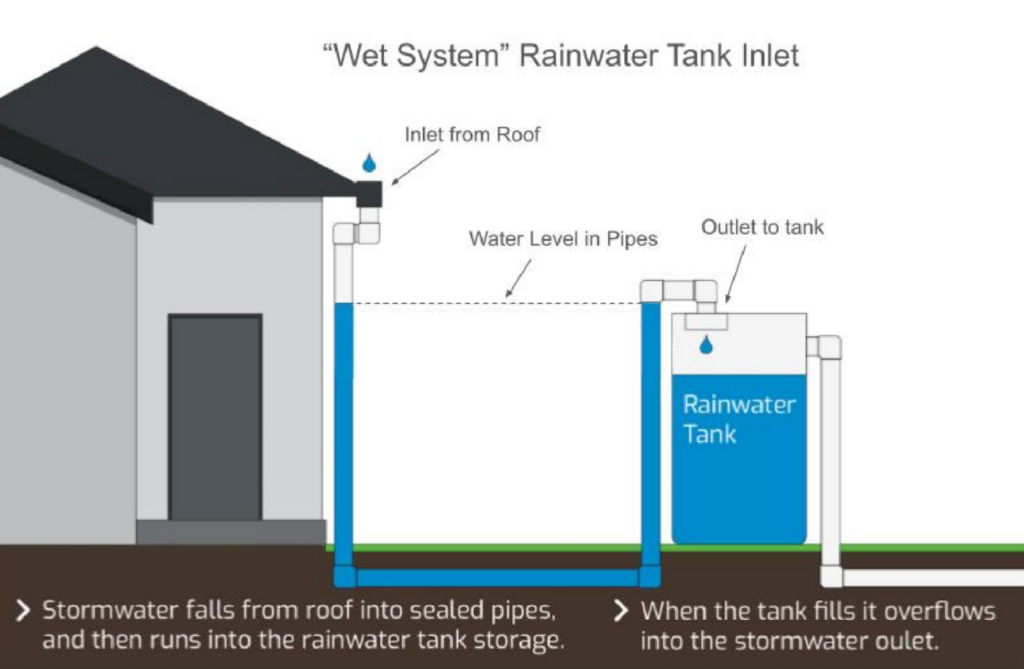
Yes. A wet system can collect water from multiple downspouts and carry it to a larger tank elsewhere in the yard, including a location where the tank is less visible. Watertight pipes run down from the downspouts, often underground, then rise to the tank inlet. During a storm, water fills the pipes until it reaches the inlet and flows into the tank. This lets you connect a larger area of roof while giving you more flexibility in where you place the tank.
Your roof’s rainfall potential might be bigger than you expected. The next step is making a plan that fits your garden and your property. It is important to ensure that your rainwater tank is properly installed for longevity, lower maintenance, and ease of use. You can start with Catching H2O’s DIY installation guide, learn at a hands-on class, or request a consultation for help planning or installing your system.